Picture Books

Gone is Gone by Wanda Ga’g | Book Review

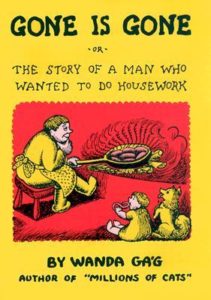
Disclosure: I did not receive any compensation for this review. Cover art is copyright of Minnesota Press.

‘Gone is Gone’ or ‘The Story of a Man Who Wanted to Do Housework’ is retold here by Wanda Ga’g, after being passed down orally through generations of her family. The book is dedicated “To My Peasant Ancestors.” This is how I intend to dedicate my future memoirs.

Fritzl and Liesi live and work on their land. Fritzl works out in the field all day. Liesi works in and around the house and looks after the baby. Fritzl believes that he works harder than Liesi and has no issue in saying so.

“Little do you know, Liesi, what a man’s work is like, little do you know! Your work now, ’tis nothing at all.”

Liesi wallops him, takes the child and leaves him. Alas, I kid. She is instead miraculously bemused by his misogyny. She suggests that they swap workloads for a day.

‘Gone is Gone’ is titled thus because every time Fritzl screws up one of the chores, he shrugs and says “Na, na! What’s gone is gone.” Is it such a wonder that he’s so easy on himself after dismissing his wife’s hard word? A ripping display of male entitlement.

Fritzl’s incompetence amplifies until he has put the lives of his dog, his cow, his child and himself in jeopardy. What an idiot. Even so, Liesi is patient and kind with him, though an “I told you so” is heavily implied – and well-deserved.

‘Gone is Gone’ is is a fine tale of comeuppance for adults and children alike.

3 out of 5 stars

Books

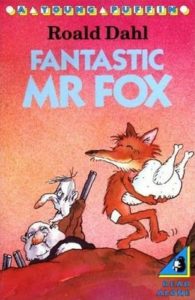
Fantastic Mr. Fox by Roald Dahl | Book Review

Disclosure: I did not receive any compensation for this review. Cover art is copyright Puffin Books.*

This is the story of Mr. Fox, who feeds his family by poaching from three farmers. Naturally these farmers are miffed and come after Mr. Fox, placing his family and all his neighbours’ lives in jeopardy.

What – an – idiot.

The three farmers are mean, mean, mean. They are also ugly. If there is one thing I have learnt from Roald Dahl, it is that mean people are ugly, and ugly people are mean. Still, these mean ol’ blokes do work for a living. They may be cruel, but they are understandably ticked off by Mr. Fox’s antics.

I don’t sympathise with the mean farmers, but I don’t sympathise with Mr. Fox either. He is too clever for his own good. No, he thinks he’s cleverer than he is. His taunting of the farmers has dire consequences.

Both Mr. and Mrs. Fox are terrible parents. Not only does Mr. Fox put his children’s lives on the line, but Mrs. Fox wails about how her children are going to die…right in front of them. She also tells them she would rather have them slowly starve to death than catch a bullet. Then Mr. Fox puts them to work on empty stomachs. And the prize for Worst Parents Ever goes to…the Foxes!

Naturally Mr. Fox’s clever solution is to do more poaching from the three farmers. What could possibly go wrong? He even ropes in other animals to help him out in his criminal activities.

What is meant to make Mr. Fox sympathetic? Is it that he is an animal being hunted? Mr. Fox is a carnivore, killing animals left and right. Only those poor creatures didn’t do anything to Mr. Fox. Hypocrite!

‘Fantastic Mr. Fox’ is the story of a fox that is in no way fantastic. It is a tale of gross entitlement that seeks to glorify criminal activity.

2 out of 5 stars
*I bet Mr. Fox would kill and eat puffins.

Picture Books

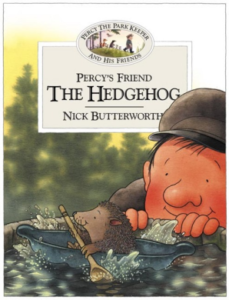
Percy’s Friend the Hedgehog by Nick Butterworth | Book Review

Disclosure: I did not receive any compensation for this review. But if anyone is looking for any other hedgehog subjects for future projects, they can contact my personal assistant. Cover art is copyright of Harper Collins.

Percy is a park keeper. All of his friends are animals, because why not?
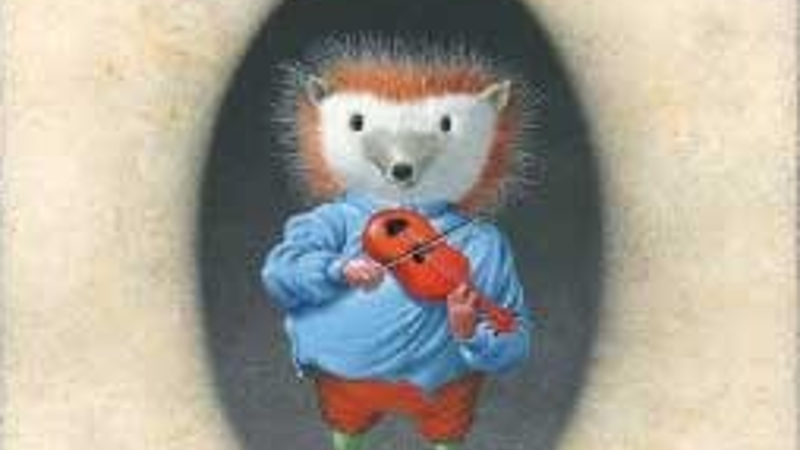
This is not as much a story as snippets and excerpts about a particular hedgehog and Percy’s friendship with him. Included within are the hedgehog’s likes and dislikes, a poem, the hedgehog’s favourite places, and more.

It should be clarified that this is a specific, unnamed, hedgehog. He is an individual and is not representative of a typical hedgehog. In fact, he seems to have some quite extraordinary – if not unbelievable – attributes.

For starters, the hedgehog seems to get things stuck to his head a lot, including apples. Hedgehogs cannot get apples stuck to their heads. This is a ridiculous myth peddled by literature. Please do not put apples on hedgehogs.

The hedgehog continuously laments that other animals are getting prickly with him about his prickles. (See what I did there? I’m so clever.) He writes a poem about his run-in with a duck and how he “jabbed her.” Please, ducks aren’t that delicate. It’s not like he tackled a naked more rat.

This hedgehog is apparently a “worrier.” He is afraid of many things, and yet not afraid of the fox, whom he has picnics with and tries to teach to colour. The hedgehog’s colouring ability is something akin to a superpower. Hedgehogs do not have good eyesight. Also, what hedgehog would have a picnic with a fox? If a fox invited me to a picnic, I’d assume I was the main course – especially if I was a “worrier.”

There are some nice aspects of the book. I liked the snow hedgehog and how the hedgehog liked to swing on the swing. The pictures are beautiful (best viewed through glasses if you’re a hedgehog) and my favourite was the double-page spread of autumn.

I am rather sceptical of Percy’s hedgehog friend. Perhaps I need to meet him for myself. I do not know if I will be picking up any of the other books about Percy’s friends. Definitely not the one about the fox!

2 out of 5 stars

Picture Books

Hans My Hedgehog by Kate Coombs, Illustrated by John Nickle | Book Review

Disclosure: I did not receive any compensation for this review. I tried to contact the Brothers Grimm in a seance to see if they had any long lost manuscripts I could pawn on eBay, but there was no response. Cover art is copyright of Atheneum Books for Young Readers.*

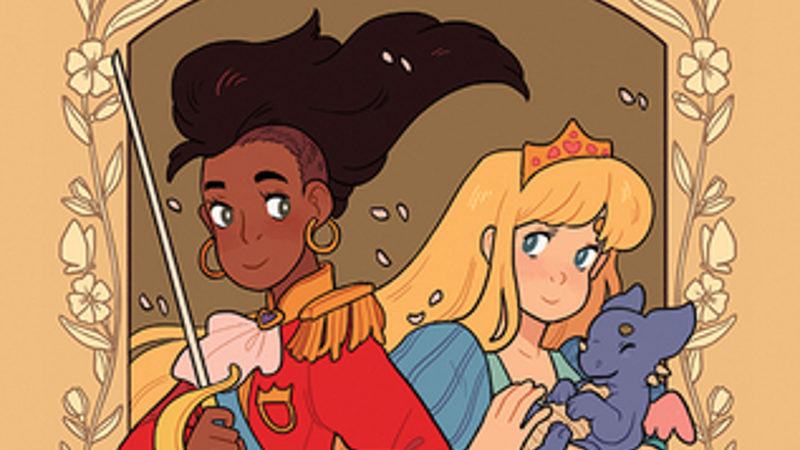
Once upon a time there was a couple who looked like they stepped out of a Renaissance painting. Like many people who are comprised of paint, they were infertile. They wished more than anything for a child. Their wish came true and they had a baby boy. This baby boy was a hedgehog with human legs. Because this couple were so literal, they named their son Hans My Hedgehog.

This is a retelling of Hans My Hedgehog, a Brothers Grimm fairy tale. Kate Coomb’s writing is seemless and John Nickle’s illustrations complement the fairy tale genre.

“Each note slipped between
the trees like a spell.
The pigs, listening below,
were steeped in magic.”

Hans – like most hedgehogs – is a bit of a loner. A self-proclaimed outcast if you will. He spends his time in the forest, frolicking with pigs, playing the fiddle, and flying on a rooster. Seems legit. The probability of a rooster flying expertly while being ridden by a hedgehog is on par with fairies, and this is a fairy tale.

Hans lives near two kingdoms. Both of these kingdoms are run by monarchs with no sense of direction, who each decide to go off on their own, and subsequently get lost in the forest. Hans helps both kings in turn, but asks that in return for his help they give him the first thing that they meet when they get home. This “thing” in both men’s cases is their daughters. Talk about objectifying women! The question is, which king will deliver when Hans comes to collect? Yes, that does sound creepy. Because it is.

This is a (marginally) less messed up retelling of Hans My Hedgehog. It’s still whack and rife with objectification and misogyny, but the original story is maximum cringe. Hans is more romanticised in this version. I’m not sure this is a good thing, but it makes for a nice story to read to your children, so that they can be traumatised by the original fairy tale later in life.

2.3 out of 5 stars
*Atheneum’s parents are Simon & Schuster. They are very proud.

Comics

Princess Princess Ever After by Katie O’Neill | Comic Review

Disclosure: I did not receive any compensation for this review. Cover art is copyright of Katie O’Neill and Oni Press.

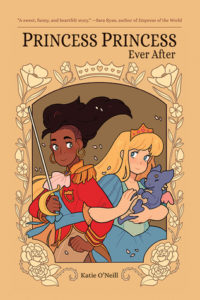
No prince has succeeded in rescuing Princess Sadie from her tower prison – but Princess Amria is no prince! Together, the two princesses will save one other and each find their place in the world.
The two princesses are endearing from the start. Amira is optimistic and determined. Sadie is outspoken and emotional. Seriously. That girl could drown a small village with her tears. It’s practically a superpower.

Amira’s rescuing methods are a little questionable. She could have maimed or killed Sadie on multiple occasions, but her perseverance is admirable. Sadie has that inexplicable sheltered blonde girl ability to solve problems with compassion. If anyone else tried this, they’d probably get themselves squished or smote.

Sadie and Amira also meet Prince Vladric. After decrying being helped by women, he then proceeds to tell them how easy they have it and how much baggage comes with the expectations of manly princeliness. Boo-hoo. I think Vladric could have been a more sympathetic character if there had been enough time in the story for more character development. Alas, he shall forever be Butthead.

‘Princess Princess Ever After’ touches on real insecurities. Amira is feeling lost, unsure of where she belongs. Sadie, belittled and degraded, bears a scar of self-doubt. Vladric…well, we covered him. The comic features a diverse cast of characters and an unspoken romantic thread between Amira and Sadie. This might have been argued as ambiguous (by the tragic and desperate) but the epilogue – which was not featured in the original web comic – makes it undeniable.

This is a short but enjoyable story for young readers (and old-er people too) from New Zealand writer and illustrator, Katie O’Neill. I look forward to reading more of her work.

3 out of 5 stars

Picture Books

Animal Music by Julia Donaldson, Illustrated by Nick Sharratt | Book Review

Disclosure: I borrowed this book from the library because it had a hedgehog on it. Also, I did not receive any compensation for this review. Cover art is copyright of Macmillan.

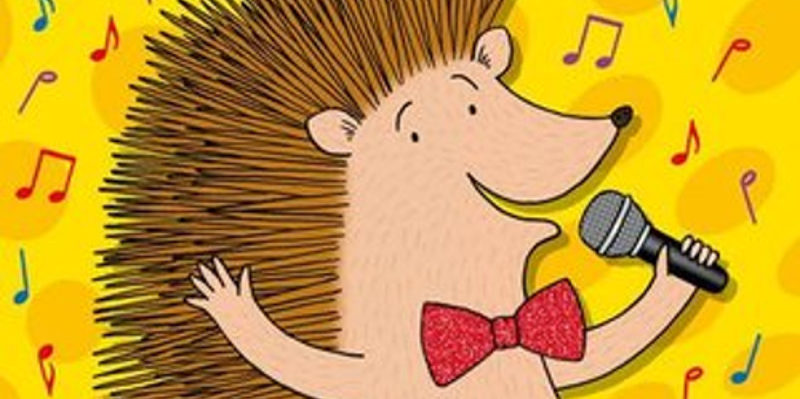
In this book, all sorts of animals are playing music. Except the hedgehog, he just hums. What are they trying to say? Hedgehogs can’t play instruments? Why couldn’t the hedgehog play the violin? They’ve got penguins playing the violin. PENGUINS! How is that even possible with their flippies?

I have been carried away. I shall compose myself. But not to music because apparently I can’t play an instrument. Just hum. Hmph.

The animals in this book include dogs, hippos, a koala, and some seafood. Is that derogatory? Sea creatures. They croon and play the spoons. I think that they have rebelled against a seafood restaurant. They have taken up the utensils that would be used to eat them and reclaimed their freedom, making music from strife.

There is a bison playing the cello that has phenomenal balance. Then there is a tiger and a carthorse. What makes a carthorse a carthorse? Is it a cart? Because this carthorse doesn’t have a cart. Is a carthorse still a carthorse if it has no cart? The tiger is beating a drum near the carthorse’s ear. I expect is aggravating, but if he complains he will be eaten.

There are also some turtles. Real turtles, not tortoises calling themselves turtles. I’m looking at you teenage ninjas! Then there is a gerbil playing a camel. Does a camel constitute as a musical instrument? Is it polite to jump around on a camel and use it as your own bouncy castle/bongo drums?

They are all playing music of different genres – pop, classical, blues and more. They are either clashing terribly or playing different set pieces. Each animal wears a sparkly red bow or bowtie. Among the animals are a diverse group of children, dancing and singing. It is night-time and they have no adult supervision.

I must conclude that this book is taking place at an international music festival to raise money for a children’s charity. Or, the animals are brainwashing all of the children, and have done away with the adults. Maybe the humming hedgehog is a hypnotist! He must be the mastermind behind it all. Yes.

‘Animal Music’ is a book packed with simple rhymes, where alliteration abounds. It is good for early readers, though I cannot say whether there is anything nefarious subliminally hidden in the text. Read at your own risk.

2.3 out of 5 stars

Picture Books

Porcupining: A Prickly Love Story by Lisa Wheeler, Illustrated by Janie Bynum | Book Review

Disclosure: I did not receive any compensation for this review. I was not even serenaded by a porcupine. Cover art is copyright of Little, Brown.

This is the story of Cushion, a lone Porcupine who lives in a petting zoo. You can imagine what a depressing life that is! Lonely and dejected, Cushion jailbreaks his pen and goes in search of a wife, banjo in hand. Yes, he plays the banjo. I can’t decide if this is magnificent or mortifying. Maybe both.

What keeps Cushion from finding a mate isn’t his prickly exterior, or his banjo playing, or his singing. Well, those might be contributing factors, but they aren’t his ultimate downfall. No, that lies in how he expresses himself.

Cushion is the Mr Collins of porcupines.

I’m not exaggerating. He is single-minded in his goal of “porcupining for a wife” (cringe) and has a talent for delivering insults as if they were compliments. When his advances are poorly received, he writes off the other party as the one at fault and continues on his way to woo his next victim.

Of course, as this is “a prickly love story” Mr Coll- Cushion manages to inexplicably find his perfect match in a beautiful hedgehog. Much like Elizabeth Bennet, I am flabbergasted…and intrigued. Critical as I may be of Cushion’s character, I am interested to know how this prickly love story will pan out – and there just so happens to be a follow-up book, ‘Hokey-Pokey: Another Prickly Love Story.’ I may read it.

My favourite illustrations in the book are actually the ones in the cover pages. The ones of Cushion trying to catch hearts in a net and a jar are very sweet, and the one of him smooching a hairbrush is simultaneously funny and embarrassing.

I would recommend ‘Porcupining: A Prickly Love Story’ to anyone who likes puns (so many puns) and stories where even the most obtuse and exasperating of creatures can find love.

2.5 out of 5 stars

Poetry

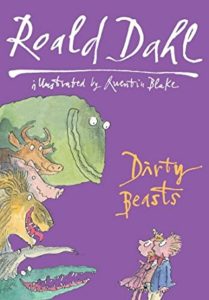
Dirty Beasts by Roald Dahl, Illustrated by Quentin Blake | Book Review

Disclosure: I did not receive any compensation for this review. I was not even accosted by any “dirty beasts.” Cover art is copyright Puffin Books.

‘Dirty Beasts’ is a book of poems by Roald Dahl about various animals, most of whom seem to be aggressive towards humans in one form or another.
Sometimes the animal is lashing out against abuse (The Anteater) or experiencing intense paranoia (The Pig) but mostly the animals seem to taunt and attack humans for pure enjoyment.

The poems follow a rhyming couplet scheme. I think that is what they are called – AA BB CC etc. Each line is eight syllables long.

My favourite poems are the shorter ones – the ones that take up less than a page or a little over. They seem to be the cleverest and have the most effective rhyming. Most of the poems dodder on for pages. They read like short stories with continuous run-on sentences and the rhythmic pace suffers.

There is no poem about hedgehogs, though one does make an appearance in one of Quentin Blake’s illustrations at the end of the poem The Porcupine. This is most unpleasant as I do not think hedgehogs deserved to be lumped in under the title ‘Dirty Beasts’ even in such a minor role.

With the exception of The Porcupine, who does nothing but be sat upon, the “beasts” in Dahl’s poems range from hungry to xenophobic. The French are stereotyped to an extravagance as rabid snail and frog eaters, and an Afghani man is referred to as a “silly foreign freak” and defecated upon.

Then there are the poems that seek to fuel the propaganda that these “beasts” live to eat little children. I must say that dousing them in butterscotch and caramel does sound rather appetizing. However, the most disturbing part of the poem The Crocodile is when an adult tells their child “Go lock the door and fetch my gun!” That is not going to end well.

The last poem in the book is about something called The Tummy Beast, which I assume is a Chestburster.

If you pick up ‘Dirty Beasts’ by Roald Dahl, I recommend The Crocodile, The Lion, and The Scorpion. These poems were enjoyable to read but the rest of the book has not left me with a desire to repeat the experience. It has only left me with one question: What is a Roly-Poly Bird?

2 out of 5 stars

Picture Books

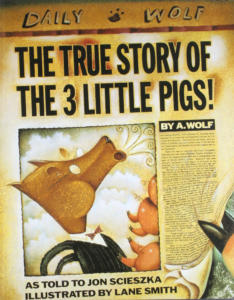
The True Story of the 3 Little Pigs by A. Wolf | Book Review

Disclosure: I did not receive any compensation for this review. I didn’t even get a cup of sugar. Cover art is copyright of Scholastic.

This is the story of Alexander T. Wolf as dictated to Jon Scieszka. It is illustrated by Lane Smith in browns, greys and dusty colours. It tells the tale of how Alexander – aka Al – was baking a cake for his sick granny when he ran out of sugar.

This is Al’s side of the “Three Little Pigs” story, which seeks to paint him as the victim of the whole ordeal. Excuse me while I scoff. I read this story and Al is far from innocent. Why? Al commits serial manslaughter.

I understand why Al would be reluctant to call the police – or a huntsman – in the aftermath of each of these incidents. Racially motivated police brutality is not the best incentive to call the authorities when you’re a wolf who has just committed manslaughter. Yet Al’s reaction to each of these accidents is ill-advised to say the least. It isn’t even the panic-induced “Whoops I just killed someone, what to do?” trope you see in the movies. It’s far more detached, which is a little unnerving.

I do not understand why Al would go door to door asking for a cup of sugar. He’s got one neighbour who’s so poor he had to build a house out of straw, one who’s busy and racist, and another who’s angry and racist. He must not know his neighbours at all, and who asks strangers for a cup of sugar?

While I don’t find Al guiltless in his actions, he is villainised by the media. They use the most threatening-looking photograph of him they can find and buzzwords like “big” and “bad” to describe him. It is spun to depict him – and wolves in general – as dangerous. This is shown on the cover page of “The Daily Pig” (All the News that’s Fit for Pigs) with the headline “Big Bad Wolf,” which includes an image of a wolf’s teeth with the caption “Seen as Menace.”

‘The True Story of the 3 Little Pigs’ is an interesting one to read with an objective eye. It does not depict A. Wolf as blameless but it does highlight how the media intertwines prejudice and sensationalism.

3 out of 5 stars